Gardens

Spacious outside areas create quiet shaded learning spaces and provide ample room for exploring.

Baby room

Babies feel secure in their own classroom, equipped with cots, soft flooring, mats and toys.

Playground

The shaded playground has specialist soft flooring with quality equipment and a large walk in sandpit.

Sunday, 17 August 2014

Top Toilet Training Tips!

Toilet training can be an exciting time for both you and your child. It marks an important transition, with your little one gaining independence and many new skills. There are millions of ideas and tips out there to support your child through this time (and stop you going barmy!), but which ones work? 

Firstly, every child is different and every parent is too. What works for one parent and child may be a disaster for another. This means there will be a certain amount of trial and error involved in finding what works for you and your toddler. What follows are some practical tips that may help you to support your child.


1. Are you both ready?

If you have ever toilet trained a child before, you will know that you need to have time to focus and lots of patience. There is no point trying to start when you are rushed off your feet or being pulled in hundreds of different directions. If that is the case, delay potty training until you have the time to really support your child. 

Your child needs to be ready too. There isn't some magical button we can press to make children ready to train, each child is different and they will let you know when they are ready. Look for signs such as them being interested in the toilet or having an awareness of their bowel movements. If you start trying and then realize they are not ready, stop and try again in a couple of months.

2. Consistency

This can make or break successful toilet training! At first you will need to take your child to the toilet at regular intervals as they will not be able to anticipate their need to go. Try every 20 or 30 minutes and gradually increase the intervals as they progress (this is why we need the time and patience!). Let them sit there for a couple of minutes even if they don't go and praise them for sitting on the toilet. 

Children will get absorbed and distracted in their games and activities so we must take them regularly. If they are busy, discuss with them where they are going and why and that their activity will be there when they get back. 

Whichever techniques you decide to use with your little one, keep using the same strategies so they know what to expect.

3. Rewards

Having a sticker chart, collecting tokens, or whatever works for you is a great way to
motivate your child. Keep it a positive experience and once they have collected a certain amount, (keep it realistic and attainable as they need to see results for their hard work) then they get a pre-agreed reward.

Do not use negative incentives such as taking away stickers or punishing them if they don't manage to make it to the toilet. This will undo all the hard work you have already done and using the toilet should be a positive experience for them. Accidents happen so don't berate them, take them to the toilet to try and do something there, remind them what to do if they need to go and change them. Don't fuss about it in either a negative or positive way. 

4. Listen to your child

If they seem scared or afraid, try and understand what it is that is worrying them. Popular fears can be falling into the toilet or being scared of the flush. Reassure them and try to make toilet time fun. New things can be scary and although the toilet is second nature to us now, it helps to try and put ourselves in their shoes.

5. Praise, praise and praise again

Successfully using the toilet is a big deal so remember to give them the positive attention they deserve. They want to impress you and make you feel proud of them. Show them you are!

6. Make it an interactive time

While toilet training it can take a while to get the timing right and can involve periods of sitting on the toilet with nothing happening. Talk to your child, sing with them, read to them so they don't get bored and want to start avoiding the bathroom.

7. Work in partnership with your childcare providers

All good childcare providers should work together with you to help toilet train your child. The key again is consistency - what happens at nursery should happen at home and vice-versa. Discuss strategies together, they should listen to you and adopt what you are trying. Due to their experience they may well have good suggestions to make, work together to integrate these with what you want to do.

8. Give your child ownership of the experience

They are big boys or girls now they are using the toilet so let them feel in control. Let them flush the toilet and try to be as independent as possible, for example pulling down their trousers and underwear, and washing their hands. Let them know you are there to support them.

9. Try and move them into 'grown-up' underwear as soon as you can

Pull-up have their uses, especially in very early stages where children may be starting to copy what they are seeing but are not quite ready to start using the toilet. Children are very smart, they know they can use the pull-ups as a crutch and it is okay to 'go' in them. 

Wearing big boy or big girl pants is very exciting, especially if you make a big deal of it and let them choose their own underwear. Yes they will have accidents but make sure you have lots of spare pairs at the ready. Your child will be more likely to use the toilet if they know they have to, rather than knowing they have the pull-up to rely on.

10. Dress them in suitable clothes

It can often be touch and go and fiddly clothes such as belts and buttons can delay things by precious seconds. Try and dress your child in easy to maneuver clothes while they are getting the hang of things. 

11. Patience, patience and more patience

Stay calm and keep persevering, Rome was not built in a day! However, know when to quit if they are really not ready and try again later. Try not to take your frustration out on them (you are only human and you will get frustrated, believe me!).

These are all tips myself, my colleagues and parents have used successfully in the past. Good luck with your toilet training and remember - practice makes perfect!

For more information and ideas, check out our Facebook page

See you soon!


 Katie is an Early Years specialist in Dubai, where she 
manages an EYFS nursery. She has a special interest 
in psychology and early childhood development.

Monday, 4 August 2014

Getting ready for nursery

When your child is starting nursery for the first time, you want to do everything you can to prepare them for their big adventure. In this post I share some of the ideas and tips I have given to parents over the years to help with the transition.

Practice separating from your child

If it is the first time you and your child will be apart then starting nursery can be tough for both of you. A good way to prepare for this is to practice leaving your child at a friend's house or other places that you trust. Start off with a few minutes apart and gradually build up the time you are away from each other. While the first few days at nursery will still be new and different, at least they will already be used to spending time apart from you.  

Spend time with children who are starting the same nursery

If you know any other children who will be attending nursery with your child, it is a great idea to get together for some play dates with them. This way they will see some familiar faces when they start nursery and already have formed some friendships.

Develop your child's independence

A good idea before starting your child at nursery is to develop key personal skills such as dressing themselves, going to the toilet independently, eating their snack and being able to ask for things. What they are ready for is dependent on their age but any skills they pick up before starting nursery will help them immeasurably and give them a head start. Things to focus on would be pulling trousers up and down, washing hands, eating finger food, opening food containers and asking when they need help or they would like something.   

Key words

A good tip is to help your child build up some key words that will help them at nursery, especially if English is not their first language. Examples of useful words are: water, juice, toilet, please, food, yes, no. This will help your child's carers to fully meet your child's needs. If your child uses another language to express themselves, be sure to write down the key words they may use so their nursery carers can understand them.

Practice routines

Nursery helps children to understand and develop routines. A brilliant idea to help your child would be to get them used to routines at home. Try and create a structure to their day, informing them in plenty of time when you are going to move from one activity to another. Sit together at meal times and encourage family discussion, making it a social time. Try and keep their routine as consistent as possible and practice things such as getting up and dressed in the mornings, every minute is valuable when you have an early nursery or school run to do!

What you can get ready

* Lunch box and water bottle - A great way to get your child excited about nursery is to
involve them in choosing their lunchbox and water bottle. They will love having the opportunity to use their 'grown-up' new things at nursery! Remember to get some ice packs to keep their food cool during the morning. Most nurseries have healthy eating policies, so bear this in mind when shopping for lunchbox snacks and try and include foods that you know your child likes. Generally, it is best to avoid chocolate and sweets, crisps, nut products and sugary drinks. Usually encouraged are fruit or vegetable snacks, healthy sandwiches, juice and yoghurts. Try and include items that your child can use independently and don't forget to give them lots of water and fluids.

* Backpack - As mentioned above, get your child involved in choosing a backpack they like. Bear in mind everything you will need to fit into the bag when choosing it as you may need a bigger one than you think! Most nurseries ask for spare clothes and nappies (diapers). It is also nice to include a favourite toy or soother, especially at the start of nursery. 

* Clothes - Every nursery teacher will agree that the more fun a child has at nursery, the more messy they will be by the end of the day! With that in mind, try and get together a collection of clothes that are suitable for nursery. These should be items that you do not mind getting dirty and ideally things that your child can manage relatively independently. Try and avoid lots of buttons, belts or fiddly catches and go for pull up trousers, skirts and tops. Another tip is to send your child to nursery in appropriate shoes. Backless shoes, flip flops and Crocs can be dangerous as their little feet can easily slip out. Try and use shoes that fit them well and will not fall off or cause them to trip up. Closed toe shoes are a good idea to protect their toes during the day. Check with your nursery when you register as some will have footwear and clothing policies.

* Documentation - Most nurseries will require certain documents when you sign your child up. Try and get these prepared so you are ready, including copies of IDs, vaccination records (making sure that they are all up to date!) and passport photos. Again each nursery may have different requirements so be sure to check with them so you can be prepared.

* Keep in touch! - Don't be afraid to contact the nursery if you have any questions, queries or just want a chat. You will be working together to take care of your child over the next year or more and you should always feel welcomed and happy to approach any member of the nursery team.


For more information and ideas, check out our Facebook page


In my next post I will be discussing potty training and providing some useful tips. See you soon!


 Katie is an Early Years specialist in Dubai, where she 
manages an EYFS nursery. She has a special interest 
in psychology and early childhood development.


- 


-   

Sunday, 13 July 2014

Eco-friendly Activity Ideas!

In this day and age, the variety of toys and games available for children is staggering. If you are keen on encouraging your child to use more natural resources for their activities, here are some ideas!

1. Growing seeds

This activity encourages us to care about our environment, as well as a whole host of other development areas!

What you need:
* Transparent plastic cups
* Fast growing seeds such as fava beans
  or watercress
* Cotton Wool
* A camera
* Watering can or similar

Method:
Your child can do this all by themselves, with a little support! Simply put some cotton wool in the bottom of the cup, place a couple of seeds inside and water regularly. Watch it grow, recording the growth with the camera!

Development tips:
This activity is fantastic for developing a child's understanding of the sequence of time and events and how things grow. It encourages them to take care of something and that things die if we do not feed them. Asking lots of questions about how it changes and how we look after it will develop their communication skills, mathematical skills and understanding of the world!

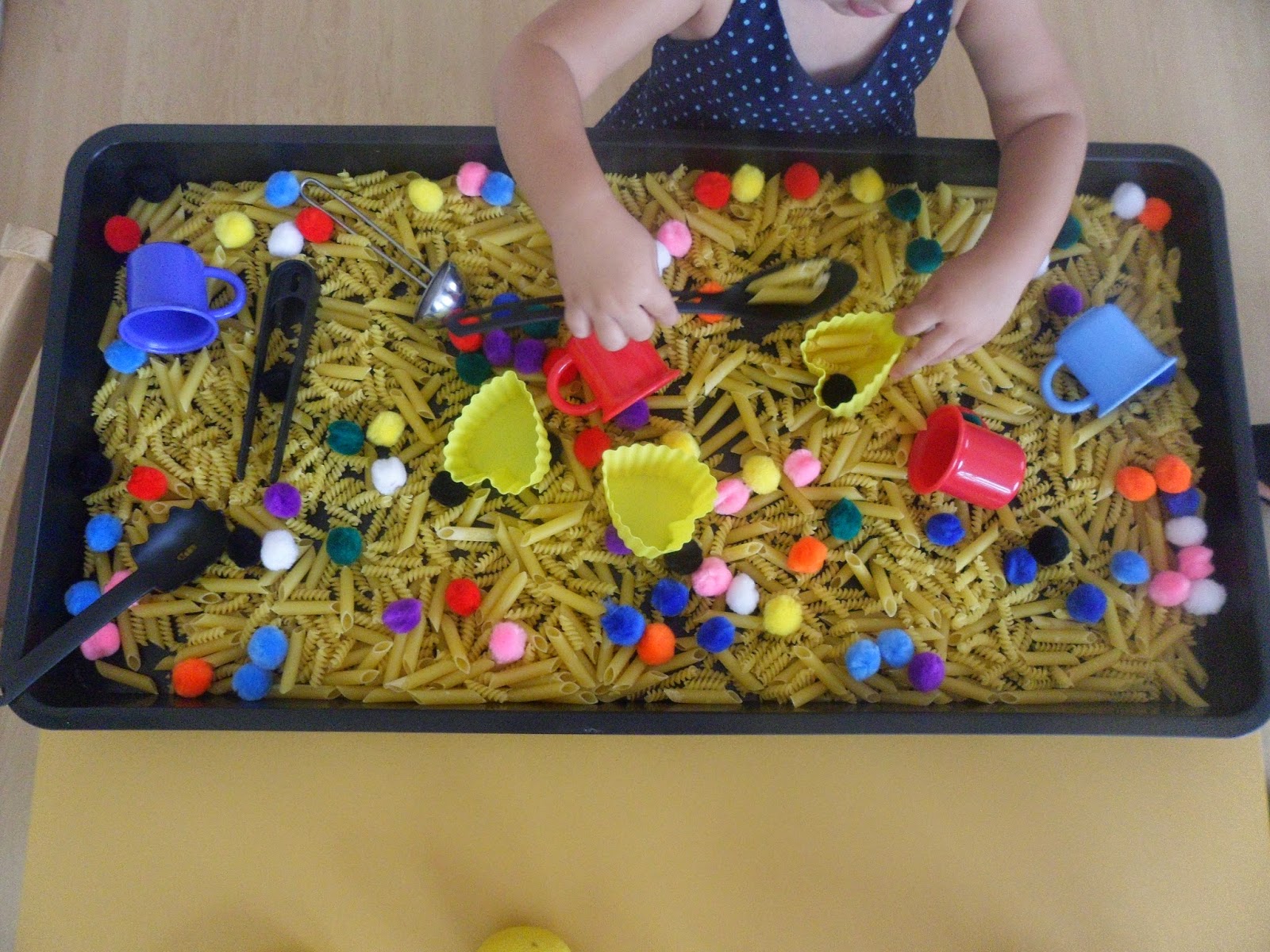
2. Pasta Play

This is an all-time favourite of mine and will occupy your little one for ages! Simple, easy, low-cost, natural and effective, what more could you want?

What you need:
* A large tray
* Dried pasta
* Assorted toys
* Cups, spoons and other measuring and 
  pouring equipment

Method:
Fill the tray with dried pasta and assorted toys. Provide various utensils for pouring, stirring and grasping (such as tongs). Let your child go wild! Vary the toys in it to keep it interesting.

Development tips:
This activity is great for sensory development. Children get a chance to explore different textures and have endless opportunities for imaginative play! Mathematical development can be incorporated by putting different types of objects in (i.e: sorting by colour, shape, size, type, counting) and communication can be encouraged by asking questions and talking to your child. The utensils provide an opportunity to develop their fine motor skills by pouring, grasping, threading, scooping....the list is endless! 

As an extension, why not ask your child to paint the pasta the day before, they they will have coloured pasta to play with!

3.  Shape Printing

An excellent way to develop creativity and learning using everyday household objects!

What you need:
* A variety of toys, food or utensils of varying shapes
* Paint
* A3 paper

Method:
Provide your child with a selection of different shaped objects for them to put in paint and print them onto the paper.

Development tips:
What an amazing chance to embrace the Reggio Emilia approach to learning by re-using objects in different ways! This will help develop your child's imagination as well as mathematical, creative and communication skills. Talk about the colours and shapes your child is printing, what they are using to print and any patterns, sequences or other observations. Once it has dried, it will look great decorating the house!

4.  Lemon Playdough

Why go out and buy playdough when you can make your own and involve your child in the process? Vary the colour, smell and added ingredients to make it different every time!

What you need:
* 2 cups plain flour (all purpose)
* 2 tablespoons vegetable oil
* 1/2 cup salt
* 2 tablespoons cream of tartar
* Up to 1.5 cups room temperature water 
  (adding slowly until you have the 
  desired consistency)
* Food colouring
* Flavouring
* Glitter
* Lemons
* Playdough equipment and utensils

Method:
Mix the dry ingredients and oil in a mixing bowl, then add the water. Stir the mixture until it turns into a sticky dough, then add the food colouring and scent. Knead the dough vigorously for a couple of minutes until all the stickiness has gone. This is very important, so keep going until you have the right consistency! If you need to, add a little more flour to get rid of any stickiness. Add the glitter and knead it in so it is evenly distributed. Your child can use the lemons to squeeze in some extra scent or as rolling pins!

Development tips:
Making playdough is a great opportunity for your child to start learning that certain items can transform into something else when a certain process is followed (another good example of this is making ice cubes). It also develops their understanding of processes and following a sequence. While making it, you can discuss colours, smells, texture and anything else that pops into your head! Kneading the dough also helps develop fine motor skills. Being a part of this process allows your child to feel ownership for something they created, which links to their personal, social and emotional development. Afterwards, it can be used in endless ways to develop their imagination, fine motor and creative skills.

Eco-friendly toys

If you want to be environmentally aware and still get your little one a treat, here are some things to look out for:

* Go for the toys that are made from
   natural materials such as wood
* Most packaging will state if the toy 
   has been made with materials from
   sustainable sources
* If you are going to go plastic, look out for    toys made from recycled plastic, a winner in  my books!
* Check if the paint, or other materials  
  used are non-toxic

And lastly....

Try and recycle as much as possible - at our nursery we ask parents to bring in all their old junk, empty cereal boxes, bits of material, cardboard boxes of all shapes and sizes.....the list is endless! These things that you were going to throw away can be given a new lease of life as important props in the 'shop', a telephone for the 'clinic', a spaceship, a princess's dress....I could go on forever! Children have fantastic imaginations, why not encourage that and be eco-friendly in the process?
  A bird feeder our children made using 100% recycled items!

For more information and ideas, check out our Facebook page

In my next post, I will give you some handy hints on preparing your child (and yourself!) for nursery....see you soon!


 Katie is an Early Years specialist in Dubai, where she 
manages an EYFS nursery. She has a special interest 
in psychology and early childhood development.
                                                                                                     

Sunday, 29 June 2014

Choosing the right summer camp


With such a wide variety of summer camps on offer nowadays, it can be hard to know which one is the best choice for your child.


Below are some benefits of summer camp and some tips on how to make the right choice. 

Why should I send my child to summer camp?

There are many reasons why going to summer camp is a great experience for your child:

It gets them up and out! They will be enjoying a day of fun, stimulating and energetic activities that will keep them occupied and entertained and they will have the opportunity to learn lots of new skills and ideas. 
  1. It helps them develop their social skills, independence and many other Personal, Social and Emotional skills.
  2. If your child has not attended school or nursery before, it can be a great opportunity to gently introduce them to the school environment before they start in September.
  3. If you choose a summer camp with lots of physical activities, it will help your child stay fit and healthy! 
  4. Creative projects can help your child develop many useful skills as well as stimulate their mind.

Which is the right camp for my child?

With the wide variety of camps on offer, it can be a difficult process knowing which one to choose for your child. There are many different factors to consider and it basically boils down to what suits your family the best.  

Most schools, nurseries and childcare centres offer summer camps and there is a huge variation in the activities offered, the hours of the camp and the price. Look for the one that you feel will stimulate your child and work with their interests.

  1. Try and find a camp that has a variety of fun activities, it is the summer after all!
  2. Ask how much opportunities there are for physical activities and games. It is really important your child has lots of chances to get active!
  3. Visit the facility before you sign up. Take a tour and see for yourself what indoor and outdoor space is available, ask about:
    •  the age range of the children (large age ranges should be split into appropriate groups)
    •  how many staff will be working (you want to know your child will have enough attention and be safe)
    • whether the staff are qualified (this is very important for the quality of care your child will receive)
    • whether there is 'tv time' (the point of summer camp is to provide fun and stimulating activities, not sit them in front of a screen)

All in all summer camp can be a fantastic experience for your child and I hope this information will help you choose the right one for your child.

For more ideas and tips, check out our Facebook page

In my next post, I will give you some ideas for eco-friendly activities and toys...see you soon!

                                 
Katie is an Early Years specialist in Dubai, where she 
manages an EYFS nursery. She has a special interest 
in psychology and early childhood development.


Sunday, 15 June 2014

Supporting your child's literacy and mathematics development at home!

There is no reason why your child’s learning should stop during school holidays. Here are some simple ways to develop your child’s Literacy and Mathematics skills at home.

Supporting your child’s Literacy development


Developing strong language and literacy skills are important for your child’s overall development and key for when they start school. 


Here are some tips on how to help your child at home during the holidays and even on weekends or after school!


1. Join in your child’s games – playing is a great opportunity for your child to develop new language skills and expand their vocabulary. Imaginative play also develops children’s comprehension of stories. By joining in, you can encourage all these skills by giving them someone to talk to. Ask a lot of questions, encouraging your child to explain what they are doing, as well as role playing with them. You will help increase their vocabulary and understanding of language, and have some fun!


2. Talk and sing songs as much as possible – ask your child what they have done today, talk about what you are doing and topics they are interested in. Try and ask lots of questions and talk about how things look, feel, work, smell or taste and how they make you both feel. Spend time singing your favourite songs together and try clapping out the rhythm of the song or syllables in words. 

3. Read with your child – spend time reading books with your child. Show them how to look after and hold books, read to them, ask them to ‘read’ the story to you (they will use their amazing imaginations here!) and discuss the story together as you are reading it. Not only is this valuable quality time but it helps develop important Literacy skills. 


4. Point out things in your environment – when you are out and about, both you and your child can point out interesting things that you see or hear. This is a great way of encouraging your child to communicate and is a fantastic distraction on long grocery shops!

5. Practice phonics – ask your child’s teacher for information on the sounds they are learning and how they are learning them in nursery. Re-enforce this at home with your little one by singing the songs or discussing initial sounds in words. Make it into a game so they learn without realizing!

Supporting your child’s Mathematics development

From birth, children are developing their mathematics skills to understand everyday life. There are so many great ways you can help your child learn key skills such as counting, shapes, colours, position and sorting. 

Here are some ideas:-


1. Counting – try counting things in the environment with your child such as the stairs to bed, crockery on the table or the number of tomatoes you are buying in the supermarket.

2.     Colours and shapes – colours and shapes are all around us and by asking lots of questions, you can help your child learn their shapes and colours. For example, ask them what circles they can see in the room (a table, coffee coaster, clock etc) or what blue things they can see. You could bring in counting as well by counting the number of items they have found! 
3. Sorting – ask your child to help with sorting items such as food, laundry or saucepan lids. There are many ways they could separate them, a great way is by size as you are re-enforcing size vocabulary and sorting skills. 

4. Position – talk to your child about the position of different objects so they learn and become familiar with position vocabulary. You could also ask them to position objects in certain places while playing (for example: can you put the cow in front of the sheep?)

5. Routines – by talking through daily routines, it helps children develop their understanding of time and sequences of events. It also helps them to become familiar with vocabulary such as before, after, next and later. 

I hope I have given you some useful ways to support your child’s learning at home. I have only scratched the surface in this post so for more information and ideas, check out our Facebook page

Have a lovely summer! 


Katie is an Early Years specialist in Dubai, where she 
manages an EYFS nursery. She has a special interest 
in psychology and early childhood development.


Monday, 2 June 2014

Helping your child stay active at home!

Having a fit and healthy child is important for all parents but in this time of ever increasing technology, how do we get our children away from the screens and exercising?

Here are some helpful tips.

How do I encourage my child to enjoy activities that don't involve a screen?

Too much time in front of a screen can inhibit creativity and the development of concentration and attention, as well as decreasing the amount of time spent in physical activities.
Here are some top tips on reducing screen time at home:-
  1. Establish a routine for time they are allocated to watch TV or use media.
  2. Replace screen time with playing fun, physical and imaginative games (ideas below!)
  3. Don’t over-emphasize the importance of screen time by using it as a reward or depriving your child of it as a consequence. Instead encourage and praise things such as healthy eating or physical activities.
  4. Make meal times a time for family communication and bonding, rather than having the TV on. This will not only help to limit screen time but also encourage communication and language development, as well as helping your family to connect.

How do I get my little one exercising?

Physical activity is so important for people of all ages, especially little ones whose bodies are growing at an amazing rate.
Why physical activity is good for children:-

  1. It helps them stay fit and healthy
  2. Physical activity produces endorphins which help your child be happy and relaxed
  3. Exercise builds strength, flexibility and endurance
  4. Lots of fresh air and exercise will help your child get lots of good quality sleep
  5. It can promote cognitive and social development, as well as developing their fine and gross motor skills
  6. Increased concentration and attention spans

Physical fun ideas:-

  1. Get outside! – When the weather is bearable, make the most of it. Take your child to a park or play in the garden. We don’t get enough opportunity to be outside in Dubai, grab every chance you can!
  2. When reading a story, act out the parts with your child, making it as silly and fun as possible. As well as moving around, this will also promote early literacy development :) 
  3. Play equipment – some simple resources are affordable and a great way of inspiring your children to join in games and activities. Have a look for things like hula hoops, soft balls, bean bags, cones and balancing equipment. They will give your child endless activity ideas and enjoyment!
  4. When you are moving about the house, encourage your child to move like different animals (for example: hopping like a bunny or slithering like a snake)
  5. Dance and let loose! Put on some music and get your child moving and shaking, it’s a great way of keeping fit, promoting rhythm and body control and having lots of fun in the mix!
  6. Have a look for physical fun activities in the community. 

Why not try: 

Fitness fun at My Gym Dubai - http://www.mygym.com/dubai
Music and Movement at Boogie Babies Dubai - http://www.boogiebabies.org/
Indoor play at Fun City - http://funcity.ae/
Toddler football fun at Socatots Dubai Sports City - http://www.socatots.com/

For more information and ideas, check out our Facebook page


Katie Hamdi
Katie is an Early Years specialist in Dubai, where she manages an EYFS nursery. She has a special interest in psychology and early childhood development.