Gardens

Spacious outside areas create quiet shaded learning spaces and provide ample room for exploring.

Baby room

Babies feel secure in their own classroom, equipped with cots, soft flooring, mats and toys.

Playground

The shaded playground has specialist soft flooring with quality equipment and a large walk in sandpit.

Showing posts with label early education. Show all posts

Sunday, 15 March 2015

How do I choose the right nursery for my little one?

It is that time of year again...registration season! It seems to creep up on us all and gets earlier and earlier every year! Choosing the right time to send your little one to nursery can be a difficult decision to make, and trying to decide which nursery to choose can be even harder! In this post I have tried to help a little by explaining some of the benefits of sending your child to nursery and then I have given you some tips on what to look for when choosing a nursery. Good luck!


What will your little one gain from attending nursery?

Whether it is just a couple of mornings a week, there are so many benefits to attending nursery. Here are just a few of what I think are the most important ones:-
  • Personal and social skills - being in an environment with other children will really help your little one's personal and social skills develop. Their confidence will grow as they explore and feel secure in their environment and  they will also develop their independence. Having lots of others to play with every day will develop those all important social skills, for example turn taking, sharing, group play and more. These skills are invaluable and will help them immeasurably for when they start school.
  • Lots of stimulating, fun activities - a good nursery will provide lots of amazing activities and learning opportunities for your little one. This is great for their development and will keep them stimulated throughout the nursery day!
  • Cognitive and language skills - with all the great activities on offer and the opportunities for social interaction and learning, you will see your child's cognitive development and their language skills really develop. The qualified staff will ensure that the right activities are provided and they are trained to identify the best way to support each and every child in their care!
  • Trained, qualified professionals - it is super important to any parent who exactly is looking after their children during the nursery day. Staff should be qualified and trained in their field and this means they can provide the best start in your little one's education and nursery experience. 
  • Routine and structure - I have mentioned in previous posts the importance of routine and structure. By going to nursery, they will be introduced to daily routines and have a somewhat structured environment. This is excellent for their development and for preparing them for the more structured environment of school.
So you've decided it's time to give your little one the great experience of attending nursery. But how on earth do you choose the right one? With the plethora of nurseries out there, each one claiming to offer a different type of educational benefit for your child, how do you know where to start?

Here are some tips for choosing a nursery for your little one:-

  • Visit - shortlist some nurseries based on factors that suit you such as location, educational philosophy, language of instruction, fees etc and then arrange to visit each one. I can't stress enough how crucial visiting the nurseries is. Choosing a nursery is an important decision and one that can't possibly be made without you seeing how both you and your child feel about the place. 
  • Ask the right questions and don't be shy! As a parent you need to feel 100% confident in the nursery and any good nursery will welcome all your questions, no matter how weird and wonderful you may think they are! Here are some questions I think are useful to ask:
    • Age range of the children in the class - the classes should be split into age groups as activities and learning should be age appropriate. I would recommend there being no more than an academic year within one class (for example children aged 2 or above but less than 3 on 1st September would go into the same class), some nurseries even split their classes into 6 monthly groups as at this age, children develop so fast and 6 months can actually be quite a big gap!
    • Staff/Child ratios - this is crucial to your child's safety and development. Ask how many staff will be working in the room with your child and what the adult/child ratio is. You want to make sure that your child will have enough attention and be safe.
    • Staff qualifications - ensure the staff are qualified as this is very important for the quality of care your child will receive.
    • Open-door policy - does the nursery welcome visits and parents? How do they welcome and communicate with their parents? For example do they have communication diaries, do they chat to parents on drop-off and pick-up? Are staff happy to see parents and spend time with them? Are they open and friendly?
    • Settling in procedures - ask about the procedure for settling in and discuss your child's needs. Also ask what their policies are for toilet training, weaning and behaviour management. It is important you agree with the nursery's philosophy.
    • Daily structure - ask how the day is structured, do they have lots of different sessions? Young children need to change activity or location regularly or they will get bored, on the other hand too often and they will not settle. There needs to be a balance. Ask what sort of activities are built into the nursery day, for example do they have regular physical fun activities, music activities and outside time?
  • Bring your little one along! - even if they are too little to verbally tell you what they think, you will find out a lot by letting your little one spend time in the environment. Go with your gut instincts!
  • Look for the following:
    • Quality of provision and curriculum - you should be able to see a range of interesting and stimulating activities out in the classrooms that develop different areas of learning and weekly planning should be up for parents to see. The teaching staff should be able to explain to you what the learning objectives and outcomes are for the activities they have planned.
    • T.v. time - is there t.v. time built into the schedules? Can you see t.v.s or laptops playing while you are walking around? In my opinion this a big no no. We do not send our children to nursery to sit in front of screens, they are there to play, learn and interact with their peers. While there may be an occasional treat of something to watch, for example on party days or the last day of term, it should not be a regular part of the nursery day or too frequent.
    • Safety - is the environment indoors and out safe, clean, secure and welcoming? 
    • Activities - are the children able to choose what activities they want to do
      within their environment? They should be able to decide what they want to do and when. There is nothing wrong with encouragement from staff and in fact it is important to encourage the children to try a range of activities but they should not be forced. The toys and resources in the classroom should be at child-level and easily accessible for the children. There should be continuous provision in the classrooms (where there are several different areas all providing activities throughout the day, offering choice and stimulation). Some nurseries still unfortunately have "classes" where they will have one activity out per session and the whole class take part. This goes against modern Early Childhood recommendations and we know that young children will not benefit from this kind of learning. There should also be a balance of child-led activities (for example, a group of children playing shops in the role play corner) and adult-led activities (for example, a child is sitting with a teacher and they are grouping compare and sort bears by size).   
    • Children - do the children in the classrooms seem happy, settled and stimulated? Are they well-occupied?
    • Staff - do the staff appear professional, relaxed, calm and friendly? Do they get down to the child's level (sitting on the floor, crouching down to talk to them etc)? 
  • Try and keep notes on each nursery and look for the same criteria every time so it is easier to compare and make your decision in the end. It may be that as soon as you walk into a nursery you instantly know that it is the right one! If so then great, but at least with these tips, you can make some further enquiries before taking that all important final decision.
Good luck with the nursery hunt, remember it is a very important time in your little one's development and nursery can be a huge benefit! Take the time to ensure that the nursery you choose is the right one for you and your little one and you should see them grow, develop and thrive!

For more advice and ideas, check out our Facebook page

See you soon!


Katie is an Early Years specialist in Dubai, where she 
manages an EYFS nursery. She has a special interest 
in psychology and early childhood development. 


Sunday, 22 February 2015

Fine motor skills - advice and activities to help support your little one!

This post is all about fine motor skills - what they are, why they are so important and how we can help our little ones to develop them.

So firstly, let me explain what fine motor skills are:

Fine motor literally means the movements that we make which are controlled by the small muscles in our hands. From birth we start to use our hands to explore the world around us, and as we grow, we begin to gain more and more control of our movements along with our gross motor (whole body) movements. 

Typically, babies start by using grabbing movements or waving their hands, then as your little one grows older and starts to develop their control and cognitive skills, they will be able to accomplish more complex movements such as gripping a crayon or successfully using a zip. As your little one continues their journey through nursery, they will refine their skills and by the time they are ready for school, they will have developed enough control to hold pencils and paintbrushes using them to make marks or write, do up and undo buttons, do activities such as threading or using scissors with control as well as many other activities that require control and hand-eye co-ordination.

This is why fine motor development is so important, as it lays the foundations for vital skills that will be needed as they grow. Being able to use our hands effectively and with control is crucial for your child's ongoing development.

So how can you support your little one's fine motor development?

Below I have listed a few activity ideas you can try with your little one to help them develop their fine motor skills. Keep the activities fun and varied so your child stays stimulated and if you notice an area that needs more development, keep working on that with them. If your little one goes to nursery then have a chat with their teacher and get their ideas and advice as well. 

  • Playdough - a fantastic activity that never gets old. Ask your child to help you make playdough for added fine motor development and enjoyment! Have lots of tools they can use to cut, roll or shape the playdough and have some fun materials that they can use with it such as rice, googly eyes, dried pasta and shells.
  • Threading beads - threading is an excellent activity for developing fine motor skills. Vary the size of the beads or use alternative objects such as penne pasta, small bracelets, buttons or hollow shapes to suit your little one's age and abilities. You could even get them making pasta necklaces by painting the pasta, leaving it to dry and then threading it, this is one of my favourites and nursery children love it!
  • Make some fine motor toys - you could use a container and make holes in it for your little one to post items such as straws or shapes through or they could use them for threading. Hours of fun and relatively inexpensive!
  • Sensory mark-making - this is one of my favourite activities. Use a variety of materials such as flour, rice, lentils, shaving foam, cornflour, gloop or jelly, put them in a tray or straight on the table and let your little one have fun experimenting and mark-making in a range of textures! This is great for their fine motor development, as well as developing their creativity and understanding of the world.
  • Homemade cardboard shapes - make different shapes and use a hole punch to make holes around the edges. Your little one can then practice their shape recognition while having fun threading!
  • Finger, hand or cotton bud painting - lots and lots of fun while strengthening those all important hand muscles. Get lots of paper and some fun coloured washable paint and let your little one go wild!

  • Sorting and stacking objects - both these activities have numerous possibilities and are really good for developing those little hand muscles, as well as mathematical or language skills. Use materials such as blocks, shells, buttons, cups, pasta...the list is endless!
  • Collaging activities - start off with getting your little one to tear up pieces of different textured or coloured paper and stick them on to create a fantastic work of art. As they get older, you can ask them to start cutting the pieces instead!

For more activity ideas, check out our Facebook page

See you soon!


Katie is an Early Years specialist in Dubai, where she 
manages an EYFS nursery. She has a special interest 
in psychology and early childhood development. 

Sunday, 7 December 2014

What are the benefits of early 2nd language learning?

In a multi-cultural place like Dubai, you can hear a multitude of languages every day. The benefit of living somewhere like this is that as well as constantly hearing different languages being spoken, most schools and nurseries will offer some kind of 2nd language tuition. So what are the benefits of your little one learning a 2nd language early on and how can you support them?  

Benefits of early language acquisition

  • Your little one's brain is like a sponge and is designed to learn languages from before birth. 
  • During this period of early childhood, your child is very able to mimic accents and pronunciation, enabling them to develop near-native pronunciation, something adults and older children have a much harder time doing.
  • As language acquisition is so important in their early years, even when learning a foreign language, children are more able to understand and use the rules of different languages so find it easier to learn. 
  • As it is easier to learn languages at a young age, you child won't feel the difficulties of language learning that older children and adults do, and should find it fun!
  • It is thought that because the brain can simultaneously run two (or more) languages and can switch between the two, early 2nd language acquisition can have cognitive benefits such as better ability to multi-task, increased observation skills and enhanced problem solving skills.   
  • As well as the cognitive benefits, it has been suggested there are academic benefits too such as improved reading and writing skills and of course being able to speak more than one language opens up doors for the future, for both academic and employment opportunities!

How can you support your little one when learning a new language? 

  • If you are keen for your child to learn a 2nd language, look for nurseries or schools that have this option. 
  • If you have friends or family who speak the 2nd language, encourage them to use this language around your little one, it is amazing what they will pick up!
  • Make it fun! - If it is fun, your child will enjoy it, be more likely to retain what they have learnt and be more interested in learning other languages in the future.
  • Encourage your child - even if you don't speak the language, show your child how proud you are of them and keep them interested and excited to learn. Also see if there are events in your area that promote the culture or language that your child is learning. You could also look for books, songs or programs that incorporate this language. For example, Dora the Explorer is great for helping little ones learn some basic Spanish :)
I hope you and your children enjoy all of the benefits learning a 2nd language has to offer, have fun!

For more information and ideas, check out our Facebook page

See you soon!


 Katie is an Early Years specialist in Dubai, where she 
manages an EYFS nursery. She has a special interest 
in psychology and early childhood development. 


Sunday, 23 November 2014

How can I support my child's literacy development using phonics and music?

In my last post, I talked about why I feel early literacy is so important and how we can support our child's development through story-time and imaginative play. 

In this post, I continue the theme by discussing the importance of phonics and music in early literacy.

Phonics

You will definitely have heard of phonics as it has long been one of the buzzwords in Early Years, but what exactly is phonics and why is it so important?

What is phonics?

Phonics is about learning sounds rather than letter names. This makes it easier to sound out letters and then blend them together to read a word. Learning that a series of letters make up a word is not an easy concept for little minds to grasp and it has been proven that phonics is much more effective when learning to read than the more old-fashioned wrote learning methods.


While the various phonics programmes all have slightly different ways of delivering phonics, they all have some main components:
  • Becoming familiar with sounds - most programmes will start with the most common sounds, such as 's' or 'a', moving through to more complex sounds such as 'ng'. Many programmes have an action that goes with each sounds and often a song. These are great ways to help your little one remember the sound and you can introduce the action or song early on, making phonics fun!
  • Recognising initial sounds - ask your child if they can think of words that start with a
    We made a sun to practise the sound 's'.
    certain sound, for example 's' sun. This is a first step in becoming aware that a group of sounds make up a word and you can introduce this concept using lots of fun games!
  • Becoming familiar with the letter - the next step is to associate the letter with the sound. See if they can recognize the letter by naming it with the correct sound. Once they are able to do this, they can start to write the letter which can be done in lots of fun and creative ways.
  • Recognizing end sounds - once your child is able to pick out end sounds as well then they are almost ready to start blending sounds to make words!
  • First words - try giving your little one 'consonant-vowel-consonant' (CVC) words such as 'cat' or 'pen' to try and read. This ability to sound out all the sounds and blend them together is key for early reading. While English can be a difficult language to read due to its large amount of non-phonetic spellings, this ability to decode a word will stay with them for the rest of their lives.

What can I do?

We played tennis to reinforce the sound 't'!
It can be quite easy and very rewarding for you to support your child's literacy development by helping them learn their sounds. If they are at nursery or school you could find out what sound they are learning about and reinforce it at home by playing games and doing fun activities. There are a plethora of interesting new ways to learn sounds. Some ideas to get you started are:
    • A treasure hunt to find items with the same initial sound
    • Creating art work that starts with a certain sound
    • Having a tray full of objects or sensory play with items with the same initial sound
    • Sorting objects by initial sound
    • Sing the song or practice the action associated with it (check with your child's nursery or school to make sure you follow what they are teaching)

    Music

    I am a huge fan of introducing babies to music. Children can get so much out of music and
    movement activities, as well as music being known to enhance your mood, attention span and learning capabilities. Music also has an important role to play in early literacy and here are some reasons why:
    • Music can help develop listening skills - when young children are listening to music they develop their ability to focus on different sounds, patterns, rhymes and the structure of language. Music gives them a chance to develop these skills in a fun, informal way!
    • Music builds a sense of rhythm - by building their sense of rhythm, children are more aware of the prosody of language - the patterns, intonation, stress and syllables we use. They will look for familiar rhythms and melodies when listening to music which is similar to identifying words with familiar sounds in reading.
    • Songs can tell a story - as well as just hearing language spoken by others or a story in a book, music is another medium where language can be explored. Songs not only practice skills such as rhyming and alliteration but they can also tell a story. 
    • Repetition - the repetitive nature of many songs and rhymes helps children identify familiar words, both spoken and in print, a great skill for emergent readers.

    What can I do?

    As you can see, music has lots of links to literacy and it can be a fun way of introducing key concepts to your little one. Some ways of encouraging literacy development through music are:
    • Sing lots with your child - encourage your little one to enjoy music and songs by singing and moving with them as much as possible.
    • Use song books - stories put to music can be a brilliant way of encouraging a love of stories and can help with recalling new vocabulary and familiar words, as well as developing their sense of rhythm and beat.
    • Play games that develop rhyming and rhythm - there are lots of songs that involve clapping to a beat, for example 'patter-cake baker's man' and most songs have lots of rhyming words. Helping your child develop these skills will really benefit your child when they start to read.
    For more information and ideas, check out our Facebook page

    See you soon!


     Katie is an Early Years specialist in Dubai, where she 
    manages an EYFS nursery. She has a special interest 
    in psychology and early childhood development. 

    Sunday, 9 November 2014

    Why are reading and imaginative play so important for my little one?

    It seems that all you hear these days is about how important it is to read to your child from an early age and there are lots of schemes around to encourage early literacy in many countries. In this post I have attempted to explain why early literacy is so important and how you can make the most of story-time with your little one :)

    Why is it important to develop early literacy skills?

    The first few years of your child's life are incredibly important for early language and literacy development and on top of that, research has shown that developing early literacy skills is crucial for cognitive development. Due to this, it is never too early to start sharing books and stories with your little one. 

    Sharing a story involves so much more that just learning to read. There is a plethora of different skills involved such as:
    • learning to communicate effectively
    • developing vocabulary and understanding of language
    • learning about and respecting books
    • beginning to understand how books work i.e. there is a front cover, pages are turned one by one to read the story
    • developing fine motor skills through handling books and turning pages
    • turn taking and sharing
    • beginning to understand that books convey meaning
    • listening and concentrating for periods of time
    • learning to predict what will happen next
    • imagining and building their knowledge of the world around them
    As you can see, there is so much to be gained from spending time sharing and appreciating books with your little one. Developing a love of literacy early on will prepare them for the reading they will do later. As they already enjoy books reading will be fun, not a chore.

    Tips for a successful story-time!

    • Encourage your child to self-select books. This will give them ownership and involvement in their story-time and they will be happy to have their choice read out to them!
    • Show them how to hold and take care of books. They should understand that books are special, so explain that we hold them carefully, turn the pages like this, close the book when we have finished reading and put it away carefully.
    • Ask your little one to tell you the story. Discuss what you can see on each page and

      what they think is happening. Some children will happily recite a story off the top of their heads, others will need more guidance or prompting. This is a very important exercise and links to the areas of development mentioned above.
    • Adlib - you don't have to read every word in the book. Pitch the story for your child, using words they will understand. They may want to read a certain book but you feel it is too long, so instead of not reading the book, paraphrase to speed the story up. Sometimes it is fun to change the words entirely and read a story from the pictures, especially if you want it to link to a certain topic or idea.
    • Use your voice - vary the volume, pitch and tone of your voice to keep your child engaged in the story. Put on silly voices and accents to make them laugh, it turns
      the story from words on a page into something alive! That is the magic of good story telling!
    • Ask lots of questions while reading - ask your child what they think will happen next and why, and ask questions when you have finished the story (e.g. was that what you thought would happen? Who was your favourite?). Ask your child to point things out or finish your sentences. Not only does it keep them engaged but it's a great way of reviewing their development and understanding.
    • Know when to stop - sometimes it just doesn't work. Know when to stop and either read another story or leave it for another time. Reading should be an enjoyable experience, not a chore.

    How does imaginative play link to literacy development?

    Children develop early literacy skills such as talking, reading and writing through interacting with others. Imaginative play such as role-playing and small world play links to many areas of development and develops communication by taking on different characters, developing a story and having different roles (characters) in the same story.

    Imaginative play also give children the opportunity to:
    • make friends and get to know their peers
    • communicate feelings
    • interact with peers or play independently
    • investigate materials and their properties
    • join in with songs, stories and rhymes
    • re-tell or tell stories


    Why not check out my June blog post 'Supporting your child's literacy and mathematical development at home' for more ideas!

    For more information and ideas, check out our Facebook page

    See you soon!


     Katie is an Early Years specialist in Dubai, where she 
    manages an EYFS nursery. She has a special interest 
    in psychology and early childhood development. 

    Sunday, 21 September 2014

    How to establish helpful routines for your little one!


    You may have heard over and over again how important routines are for your little one but may not know exactly why they are beneficial or how to put them in place in the best way for your child. This post will explain some of the benefits of routines and hopefully give you some useful tips on implementing them!


    Why are routines so important?

    •  Stability - Just like us adults, children need routines and stability. Having a predictable routine allows them to feel safe and in control in a world where they don't have much control over anything! Lots of changes and unexpected events happen on a regular basis for children and having routines helps them to handle these events and feel confident and secure. It also helps avoid tantrums or power struggles as they are just as aware of what is going to happen as you are. Instead of just being told to do something, their routine means that they know this is the time they do 'x'. 

    • Developing important skills - Routine and structure help children to put their day in order as they do not yet fully understand the concept of time. While saying they will play outside in 20 minutes may mean nothing to them, explaining that they will play outside after they have had their snack will make sense to them. They can then prepare themselves for this. A routine also gives your little one a great opportunity to make predictions about what they will do, using concepts such as before, after, next and later. Having a repetitive order of events gives children the chance to develop organization and self-discipline skills as they will learn to be patient and look forward to activities. It also helps develop independence as the more a routine is practiced, the more they will be able to manage on their own. This is great for their self-esteem and for learning a ton of new skills!

    Top tips for establishing routines

    This is what we all really want to know....so you've got the theory but how do you put it in place? 

    • Be flexible -  Routines shouldn't be rigid or impractical, it should be a guide to help structure the day which works with both your needs and those of your little one. If there is a change to your routine, explain what is changing and why. This helps them to prepare for the change and understand what is happening, which will make them more able to deal with changes in the future. 

    • Don't try and start too early - infants will often develop a routine that suits them, which will change as they grow. Once they are a bit older, you can start to establish a routine that fits in with both your and your baby's needs. 

    • Create a bedtime routine - Having a routine order of events that your child associates with bedtime (eg: bath, pyjamas, brush teeth, bedtime story, sleep) will help your little one calm down and prepare for going to sleep. This will hopefully avoid bedtime squabbles and mean they will go to sleep earlier, giving them a better quality of sleep so they have more energy the following day!
    • Have a visual timetable - This is a winner and something I have used in all my nurseries and schools. Make it together with your child, using pictures that they can easily identify with particular activities. Each day, put the activities in the order you will follow and then go through it with your child. Use an arrow or marker to indicate which activity you are currently doing and ask your child to help you move it along the line as you transition from one activity to the next. This is great for learning concepts of before, after, next and later and also gives them the opportunity to chat about what they are going to do, developing their communication skills. It is also great as your little one can revisit the timetable at different times of the day to see what is coming up, giving them control over their day.


    • Transitions - Giving your child a warning about moving from one activity to the next is very important. Sudden transitions can be confusing and stressful for children so give your child a countdown, for example - at the end of the song we will be tidying up so we can go and play outside. This will give your child time to finish their activity and get ready to start a new one.

    These are just a few ideas that I have used successfully, I hope you find them as useful as I have!


    For more information and ideas, check out our Facebook page

    See you soon!


     Katie is an Early Years specialist in Dubai, where she 
    manages an EYFS nursery. She has a special interest 
    in psychology and early childhood development.

    Sunday, 13 July 2014

    Eco-friendly Activity Ideas!

    In this day and age, the variety of toys and games available for children is staggering. If you are keen on encouraging your child to use more natural resources for their activities, here are some ideas!

    1. Growing seeds

    This activity encourages us to care about our environment, as well as a whole host of other development areas!

    What you need:
    * Transparent plastic cups
    * Fast growing seeds such as fava beans
      or watercress
    * Cotton Wool
    * A camera
    * Watering can or similar

    Method:
    Your child can do this all by themselves, with a little support! Simply put some cotton wool in the bottom of the cup, place a couple of seeds inside and water regularly. Watch it grow, recording the growth with the camera!

    Development tips:
    This activity is fantastic for developing a child's understanding of the sequence of time and events and how things grow. It encourages them to take care of something and that things die if we do not feed them. Asking lots of questions about how it changes and how we look after it will develop their communication skills, mathematical skills and understanding of the world!

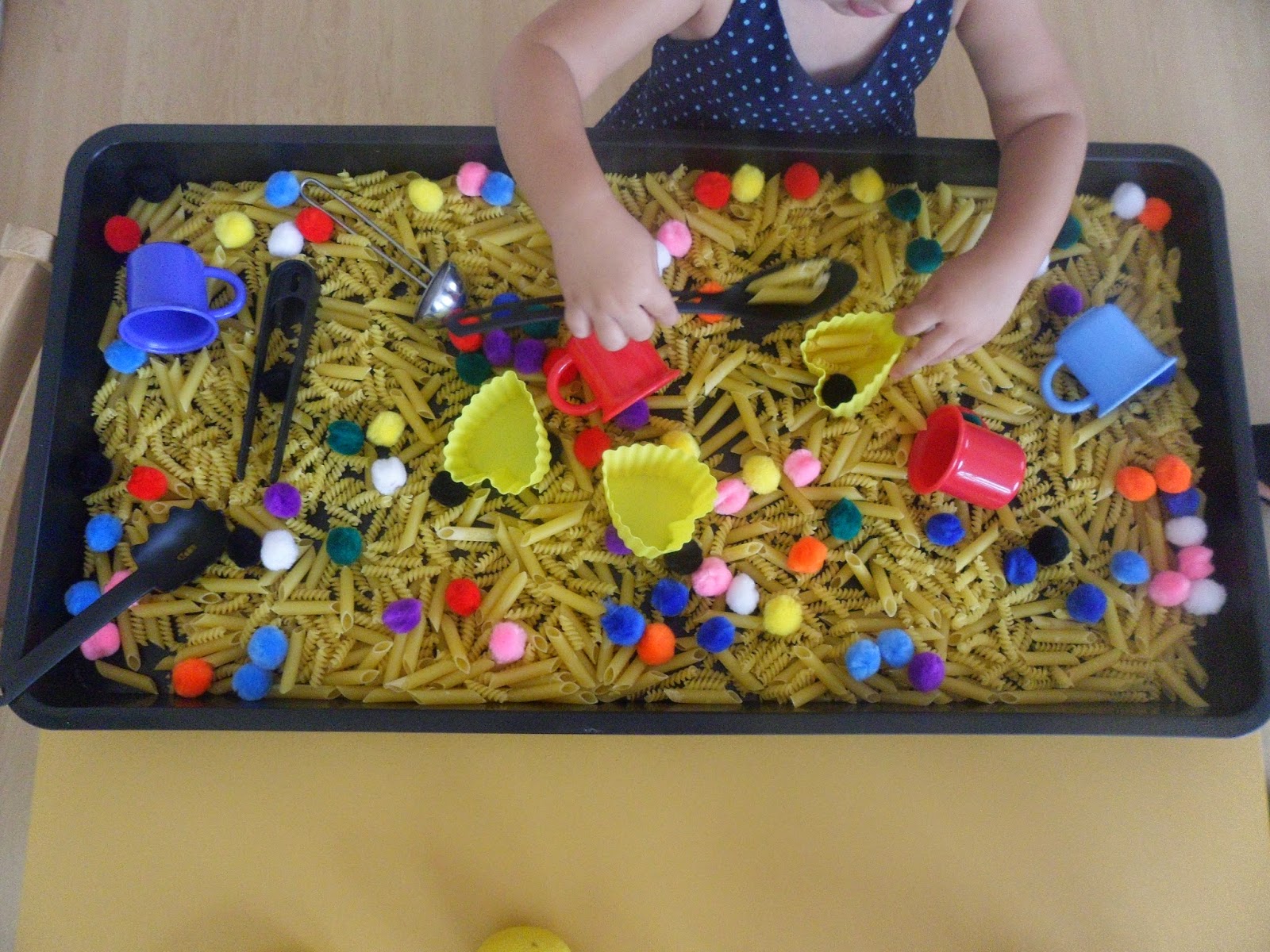
    2. Pasta Play

    This is an all-time favourite of mine and will occupy your little one for ages! Simple, easy, low-cost, natural and effective, what more could you want?

    What you need:
    * A large tray
    * Dried pasta
    * Assorted toys
    * Cups, spoons and other measuring and 
      pouring equipment

    Method:
    Fill the tray with dried pasta and assorted toys. Provide various utensils for pouring, stirring and grasping (such as tongs). Let your child go wild! Vary the toys in it to keep it interesting.

    Development tips:
    This activity is great for sensory development. Children get a chance to explore different textures and have endless opportunities for imaginative play! Mathematical development can be incorporated by putting different types of objects in (i.e: sorting by colour, shape, size, type, counting) and communication can be encouraged by asking questions and talking to your child. The utensils provide an opportunity to develop their fine motor skills by pouring, grasping, threading, scooping....the list is endless! 

    As an extension, why not ask your child to paint the pasta the day before, they they will have coloured pasta to play with!

    3.  Shape Printing

    An excellent way to develop creativity and learning using everyday household objects!

    What you need:
    * A variety of toys, food or utensils of varying shapes
    * Paint
    * A3 paper

    Method:
    Provide your child with a selection of different shaped objects for them to put in paint and print them onto the paper.

    Development tips:
    What an amazing chance to embrace the Reggio Emilia approach to learning by re-using objects in different ways! This will help develop your child's imagination as well as mathematical, creative and communication skills. Talk about the colours and shapes your child is printing, what they are using to print and any patterns, sequences or other observations. Once it has dried, it will look great decorating the house!

    4.  Lemon Playdough

    Why go out and buy playdough when you can make your own and involve your child in the process? Vary the colour, smell and added ingredients to make it different every time!

    What you need:
    * 2 cups plain flour (all purpose)
    * 2 tablespoons vegetable oil
    * 1/2 cup salt
    * 2 tablespoons cream of tartar
    * Up to 1.5 cups room temperature water 
      (adding slowly until you have the 
      desired consistency)
    * Food colouring
    * Flavouring
    * Glitter
    * Lemons
    * Playdough equipment and utensils

    Method:
    Mix the dry ingredients and oil in a mixing bowl, then add the water. Stir the mixture until it turns into a sticky dough, then add the food colouring and scent. Knead the dough vigorously for a couple of minutes until all the stickiness has gone. This is very important, so keep going until you have the right consistency! If you need to, add a little more flour to get rid of any stickiness. Add the glitter and knead it in so it is evenly distributed. Your child can use the lemons to squeeze in some extra scent or as rolling pins!

    Development tips:
    Making playdough is a great opportunity for your child to start learning that certain items can transform into something else when a certain process is followed (another good example of this is making ice cubes). It also develops their understanding of processes and following a sequence. While making it, you can discuss colours, smells, texture and anything else that pops into your head! Kneading the dough also helps develop fine motor skills. Being a part of this process allows your child to feel ownership for something they created, which links to their personal, social and emotional development. Afterwards, it can be used in endless ways to develop their imagination, fine motor and creative skills.

    Eco-friendly toys

    If you want to be environmentally aware and still get your little one a treat, here are some things to look out for:

    * Go for the toys that are made from
       natural materials such as wood
    * Most packaging will state if the toy 
       has been made with materials from
       sustainable sources
    * If you are going to go plastic, look out for    toys made from recycled plastic, a winner in  my books!
    * Check if the paint, or other materials  
      used are non-toxic

    And lastly....

    Try and recycle as much as possible - at our nursery we ask parents to bring in all their old junk, empty cereal boxes, bits of material, cardboard boxes of all shapes and sizes.....the list is endless! These things that you were going to throw away can be given a new lease of life as important props in the 'shop', a telephone for the 'clinic', a spaceship, a princess's dress....I could go on forever! Children have fantastic imaginations, why not encourage that and be eco-friendly in the process?
      A bird feeder our children made using 100% recycled items!

    For more information and ideas, check out our Facebook page

    In my next post, I will give you some handy hints on preparing your child (and yourself!) for nursery....see you soon!


     Katie is an Early Years specialist in Dubai, where she 
    manages an EYFS nursery. She has a special interest 
    in psychology and early childhood development.